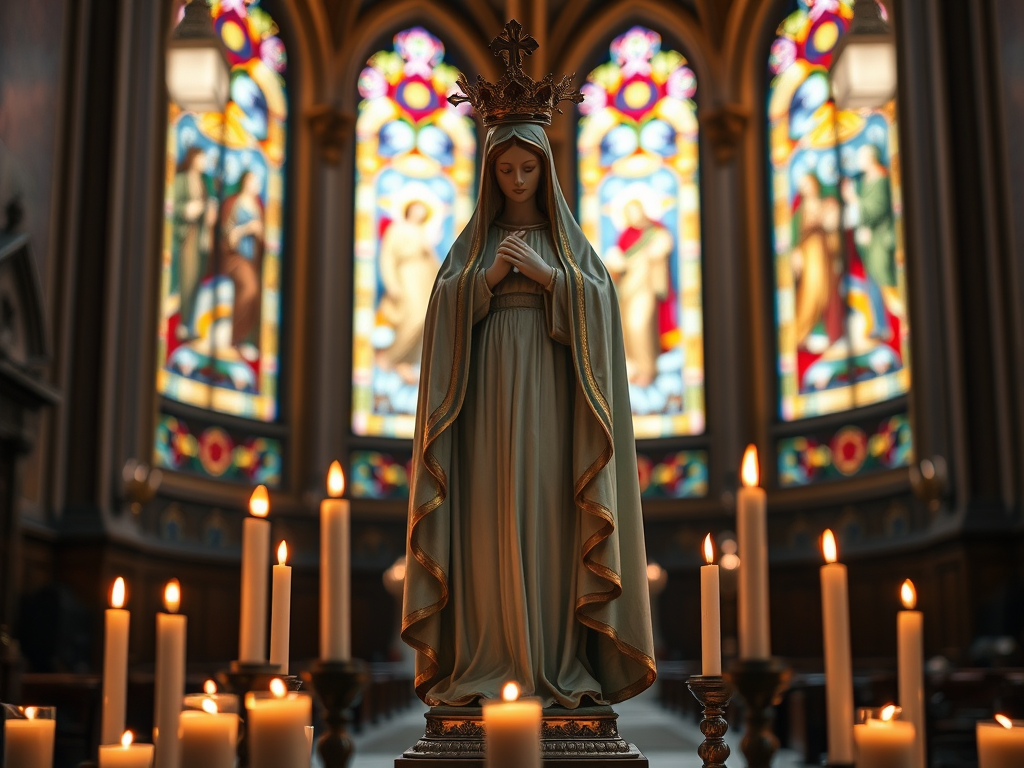
Journalists must summarize, so it is understandable that the headline—“Pope Leo Declares Jesus Alone Saved the World, Rejects Title of Mary as ‘Co-Redeemer’”—fails to capture the complexity of the lengthy Note from the Vatican’s doctrinal office, and approved by Pope Leo XIV.
Published on November 4, 2025, this Note, Mater Populi Fidelis, seeks to answer the question: How should Catholic Christians think about their devotion to Mary? In their reverence for the Blessed Virgin, should they use such titles as “Co-redemptrix” or “Mediatrix”?
The answer from the Vatican is unequivocal. It is not appropriate to call Mary “Co-redemptrix.” And as for “Mediatrix”—it shouldn’t be used unless it is carefully qualified. In the words of the Note: “The expression ‘Co-redemptrix,’ carries the risk of eclipsing the exclusive role of Jesus Christ” (§22). Moreover, without scrupulous explanation, the title “Mediatrix” could confuse the unique role Jesus has as mediator between God and humans.
Maybe that’s why the Protestant reaction, by and large, seems to be something like: “Ah, now they’re starting to get it right.” Some have even expressed cautious optimism that the Vatican is moving in a more Protestant direction.
Being a Protestant Christian myself, I’m not familiar with what I may assume are the swirling undercurrents leading to the publication of this Note, except for what the document itself said, noting specifically the role of “social media” in “sowing confusion among ordinary members of the faithful.”
I do know, however, that we are living in a time when church-switching seems to be on the rise: yesterday, Dr. So-and-So was a Baptist; today he is Anglican; yesterday, Mr. So-and-So was a Presbyterian; today, he is a Catholic; and so on. Therefore, in view of an announcement that sounds tantalizingly Protestant, it’s worth trying to understand exactly what it says and how it compares with Scripture.
There are two important things to understand about this document. I’ll point these out, then seek to weigh them against the teaching of the New Testament.
1. Mater Populi Fidelis is seeking to navigate the tension between devotion to Mary and devotion to Jesus.
To be more precise, the dicastery is concerned to uphold two beliefs, along with the devotional practices they lead to: first, the belief that Jesus occupies a unique and unparalleled role in human salvation; second, the belief Mary also occupies an important role in salvation—a role so important that she has present influence on the lives of Christians, and deserves their devotion.
Ideally, these beliefs shouldn’t produce any tension in Catholic devotional prayers and practices. The devotion due to Mary shouldn’t encroach on the devotion due to Jesus. Apparently, however, this is precisely what has been happening: thus the Vatican’s concern. Mary—not to be irreverent, but to help make it vivid—is being offered part of a pie that belongs to Jesus alone.
This is why the Note disallows titles or descriptions that would put Mary on the same plane as Christ.
When it comes to the title “Co-redemptrix”—
It is always inappropriate to use the title “Co-redemptrix” to define Mary’s cooperation. This title risks obscuring Christ’s unique salvific mediation and can therefore create confusion and an imbalance in the harmony of the truths of the Christian faith, for “there is salvation in no one else, for there is no other name under heaven given among men by which we must be saved” (Acts 4:12) (§22).
[Calling Mary a “Co-Redeemer”] carries the risk of eclipsing the exclusive role of Jesus Christ — the Son of God made man for our salvation, who was the only one capable of offering the Father a sacrifice of infinite value — which would not be a true honor to his Mother. Indeed, as the “handmaid of the Lord” (Lk 1:38), Mary directs us to Christ and asks us to “do whatever he tells you” (Jn 2:5) (§22).
But where does this leave the part of the pie due Mary? According to the Note, it is not diminished in the least. For, “Mary, as Mother, has a presence in the daily lives of the faithful that is far greater than the closeness any other saint could have.” It affirms that “Mary’s intercession and her maternal closeness … invite us to open our hearts to God’s sanctifying grace” (§56). Indeed, the preface to the Note establishes that part of its goal is to “accompany and sustain the love of Mary and trust in her maternal intercession” (§68).
Thus, the writers of the Note seek to thread the needle between devotion to Jesus and devotion to Mary by clarifying that Mary’s mediatorship does not detract from Jesus’ unique mediatorship; rather she acts in a kind of preparatory role, “preparing us to receive God’s sanctifying grace.” According to the Note, therefore, when titles are clarified and devotion properly defined, a person’s devotion to Mary need not detract from devotion to Christ.
2. Mater Populi Fidelis is designed to encourage Marian devotion, not diminish it.
The stated purpose of the Note, therefore, is not to limit devotion to Mary, but to encourage it. Here is where a superficial reading of the headlines can be misleading. To the Protestant imagination, the headline, “Pope Rejects Title of Mary as Co-Redeemer” may conjure the ironic image of a Lutheresque pope nailing a new Ninety-Five Theses right on the door of the Vatican. Nothing could be further from the truth.
This point may be established clearly enough by two quotes. The preface states that “the piety of the faithful People of God — who find in Mary refuge, strength, tenderness, and hope — is not contemplated here to correct it but, above all, to appreciate, admire, and encourage it.” The final sentence of the Note is, in fact, a prayer to Mary: “Mother of the Faithful People of God, pray for us.” A Protestant looking for a repudiation of Marian devotion will not find it here.
A New Testament Evaluation of Marian Devotion
Can there be a “balance” between devotion to Mary and devotion to Jesus?
In view of the New Testament, does the Mater Populi Fidelis successfully navigate the tension between beliefs about Mary and beliefs about Jesus? I argue that despite its efforts to draw a line between Mary’s work and Jesus’ work, it still gives Mary honor that only Jesus (and the Holy Spirit) deserves. There can be no “balance” between devotion to Jesus and devotion to Mary as long as Mary is treated as an intercessor or hearer of our prayers.
Consider that the Note insists that “it is not acceptable to present Mary’s action as if God needed her to accomplish salvation” (§65b). It further states that “in the perfect immediacy between a human being and God … not even Mary can intervene”—intervening meaning, quite literally, “coming between” (§55). So if the connection between God and believers is that close, what place is there, as the Note says, for Mary to “intercede by asking God that we might receive the gift of grace” (§55, emphasis added)? It is the unique privilege of Jesus, attained by his—and only his—sacrificial death on the cross to be our intercessor (Hebrews 5:1-6; 7:23-28).
To cite another example: the Note firmly disavows, on the one hand, any talk of Mary’s being even “a complementary aid,” and insists that her “mediation must be understood in such a way that ‘it neither takes away anything from nor adds anything to the dignity and efficacy of Christ, the one Mediator.’” (To that I say a hearty Amen!) Why, then, does the Note go on to say, on the other hand, that Mary “contribut[es] in preparing us to receive God’s sanctifying grace”? (§65). The honor of preparing a heart to receive God’s grace, if I understand Scripture, belongs to Christ and to His Spirit alone (John 16:18; Acts 16:14).
I cannot see, therefore, how attributing to Mary a preparatory role in our receiving grace or an intercessory role in “asking God” on our behalf—actions ascribed in Scripture only to God the Son or God the Spirit—does not rob Jesus (and the Spirit) the honor due to him alone. While I’m grateful for the truth of the Note’s statements about the exclusive role of Jesus, the statements about Mary as intercessor speak against that exclusive role.
Bless Mary? “Blessed rather are those who hear God’s Word and keep it.”
What, then, is a Christian’s proper attitude toward Mary? In the pages of the New Testament, we find that Mary is undoubtedly uniquely blessed by God in that she gave birth to the God-man. Accordingly, she was and always will be part of the gospel story. Besides her role in Jesus’ birth, she interacted with him throughout his ministry, and was present at his crucifixion. We last read of her in Acts 1, when she is among those who gathered in prayer before the outpouring of the Holy Spirit.
Throughout all the epistles and Revelation, Mary’s name is never mentioned, and her role is only indirectly alluded to in connection with Jesus’ birth and humanity—for example, “God sent forth his Son, born of woman, born under the law” (Galatians 4:4; see also Romans 1:3; Philippians 2:7).
A study of Mary in the New Testament reveals zero evidence that she has any ongoing influence in the lives of believers, or that believers should pray to her or expect that her “maternal intercession might help us to persevere in life, … or grow in the life of grace” (§69).
Besides this lack of positive evidence for Marian devotion, we find something else very important—and notably absent from the Note’s presentation of Mariology. There are a couple incidents in the gospel of Luke that make it clear how Jesus wanted people to regard Mary. In Luke 11:27-28, a woman in the crowd calls out to Jesus and says, “Blessed is the womb that bore you, and the breasts and which you nursed!” In other words, “How blessed Mary must be to have a Son like you!” This would have been the perfect opportunity for Jesus to uphold Marian devotion. Instead, he takes us in a completely different direction: “Blessed rather are those who hear the word of God and keep it.”
Far from putting Mary in a special place of blessing, Jesus deflects the blessing (“rather”) from his mother, and extends it to “those who hear the word of God and keep it.” In other words, being the biological mother of Jesus in itself is no guarantee of blessedness; rather, hearing and doing God’s will is. Shocking as it may sound, the blessing that Jesus wants us to value is the blessing that comes from being his follower more even than the blessing of being being his mother.
Another key passage (also absent from the Note) is Luke 8:19-21. Jesus, when told that his mother and brothers were looking for him, identified his true family as “those who hear the word of God and do it.” Rather than finding evidence of Marian devotion here, we find priority given to obedience to God over and above a biological relationship to Jesus.
This is not, of course, to say that Mary isn’t blessed; rather—again, I’m sticking with Jesus’ words here—“blessed rather are those who hear the word of God and keep it.”
I recognize that my Roman Catholic friends will probably disagree with my conclusions here. I certainly hope they do not find this hurtful or demeaning. Much of this disagreement will be due to the different weight we give to the authority of the church relative to the authority the New Testament. It is with deep respect to these friends that I write this, hoping that they will consider that the New Testament’s teaching about Mary—far from diminishing their devotional and spiritual lives—can deeply enrich it, seeing the blessedness that is available to them in Christ alone (Ephesians 1:3).
I wish I could say that the Vatican was really distancing itself from Marian devotion—not because I don’t appreciate Mary’s role as mother of Jesus—but because prayers to Mary, no matter how carefully qualified, detract from prayers due to Jesus alone.
 Jonathan M. Threlfall