On December 29, it’s almost too late to be sharing a list of books I’ve read in 2023. But I was spurred to action partially because someone asked me to share and partially because I was jealous of my wife’s list. (It also helped to see that Tim Challies shared her list of books.)
Inferior motives aside, I can hardly overstate the importance of reading good books. If anyone would be helped, challenged, or bettered as a result of reading these books, I would be very happy.
So, in no particular order, here are some of my favorite books I read this past year.
The Elements of Rhetoric: How to Write and Speak Clearly and Persuasively by Ryan N. S. Topping
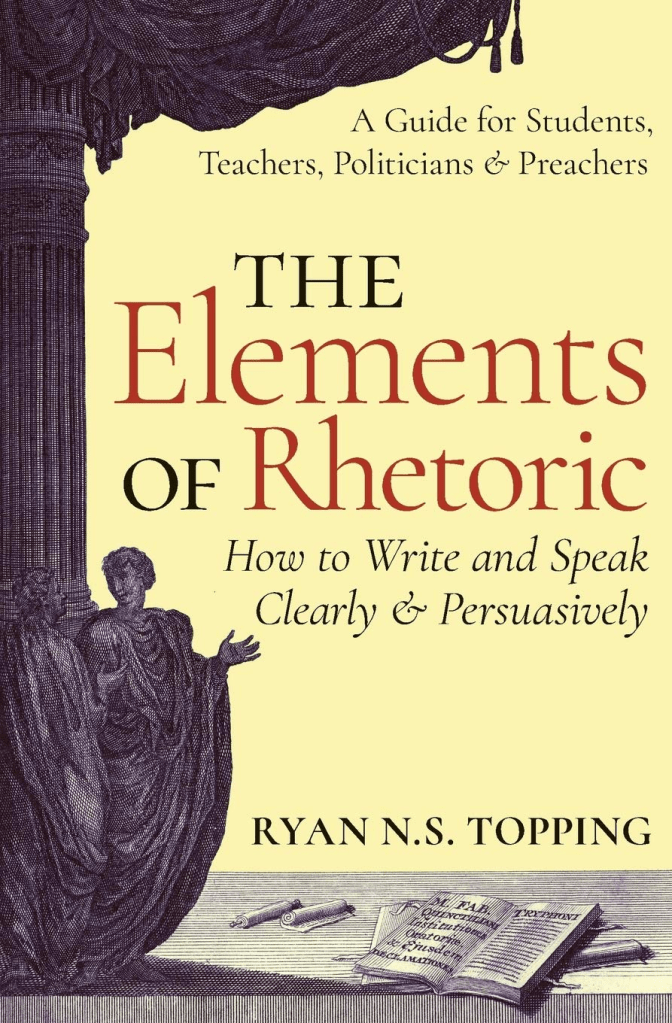
The Elements of Rhetoric is slim volume, but it’s packed with wisdom both ancient and up-to-date for anyone wishing to write, speak, and even think clearly. With its terse and punchy tone, it reminded me a little of Strunk and White’s The Elements of Style. Besides giving twenty-six rules, it also illustrates and reinforces these rules from classic literature, making this book a gateway to even greater books.
(I should give a shout-out to my friend Eric Brown for telling me about this book. I was on the phone with him when he told me about it, and I ordered it before we ended the conversation.)
“One thing is clear. In education, nearly everyone agrees that ours is a time of reconstruction, that we must grow in goodness or perish. A nation run by technical giants but ethical dwarves is hardly a nation worth defending. Such a land, marred as it will be by slovenly speech and vapid slogans, will decay into an ugly dwelling, because it will be ruled by Orcs.”
– Ryan Topping
Soul Survivor: How Thirteen Unlikely Mentors Helped My Faith Survive the Church by Philip Yancey
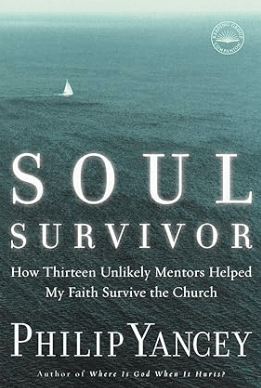
I’m not a fan of that phrase in the subtitle, “surviving the church,” but getting into the book itself helped me understanding where Yancey was coming from. Having grown up in a religious environment that had a form of godliness but lacked transforming power (i.e., was racist and legalistic), Yancey had some serious thinking to do about what it really meant to follow Christ. I found myself appreciative of Yancey’s honesty in wrestling through issues and his enthusiasm in introducing his readers to his “unlikely mentors”—Martin Luther King Jr., G. K. Chesterton, Dr. Paul Brand, Dr. Robert Coles, Leo Tolstoy, Fyodor Dostoevsky, Mahatma Gandhi, Dr. C. Everett Koop, John Donne, Annie Dillard, Frederic Buechner, Shusaku Endo, and Henri Nouwen. However, since the issues Yancey was wrestling with were of eternal import, I also found myself ultimately unsatisfied—longing, from beginning to end, for decisive guidance not from human wisdom, but from the Bible itself.
“If I had to define my own theme, it would be that of a person who absorbed some of the worst the church has to offer, yet still landed in the loving arms of God. Yes, I went through a period of rejection of the church and God, a conversion experience in reverse that felt like liberation for a time. I ended up, however, not as an atheist, a refugee from the church, but as one of its advocates.”
– Philip Yancey
Dynamics of Spiritual Life: An Evangelical Theology of Renewal by Richard Lovelace
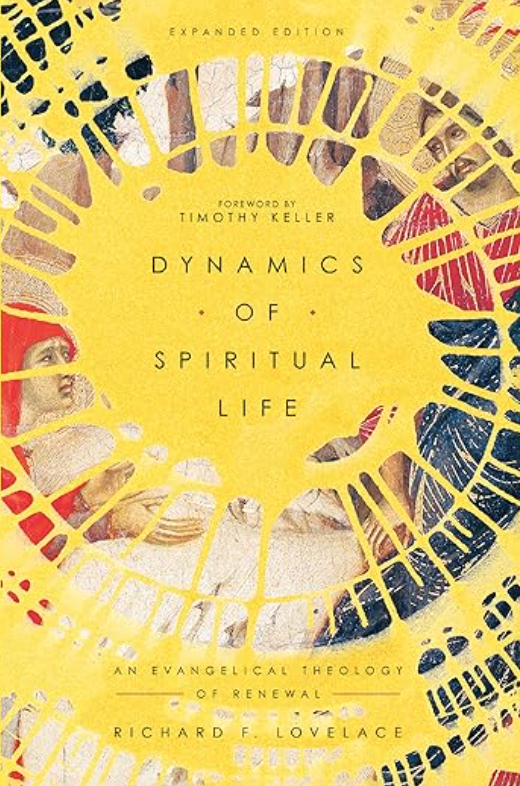
This is undoubtedly my favorite book of 2023. (I think I wore out a few people talking about it so much.) Although it was first published in 1979, most of it feels incredibly up-to-date and needed today. Lovelace described his book as “a manual of spiritual theology, a discipline combining the history and the theology of Christian experience.” It sparked in me a desire to see spiritual renewal in my own life, in the life of my church, and beyond.
“What are the essential elements of life in Christ? What are the dimensions of experience which issue from our union with him and which can be appropriated by faith and sought for in the life of the church? The answer to this question seems at first to transcend analysis. It is like a blaze of white light which contains an almost numberless succession of colors and wavelengths, “the unsearchable riches of Christ . . . the manifold wisdom of God (Eph. 3:8, 10). I am seeking to analyze this splendor into a manageable number of definite elements by refracting it through periods of renewal, the experience of the revived church in Acts and the New Testament theology of Christian experience.”
– Richard Lovelace
The Pastor as Counselor: The Call for Soul Care by David Powlison
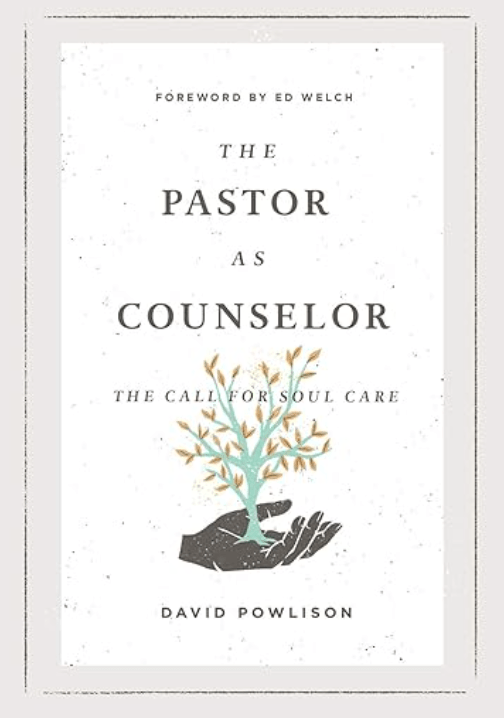
The Pastor as Counselor, with 59 pages of loosely-spaced text, is easily a one-sitting read. But this does not mean that it is a light read. Powlison loads wisdom by the pound into each phrase and sentence. I agree with Paul David Tripp’s endorsement: “If you’re a pastor, this book is a must-read, but not just once. Read it again and again, praying that its beautiful vision would become your daily ministry model.”
The book is obviously directed to pastors, but its principles are applicable to all Christians. Besides, if more church members read it, they would be better motivated to pray that their pastor would be the kind of counselor God calls him to be!
“Counseling usually starts with immediate, troubling experience, and moves toward the God whose person, words, and actions bring light. In contrast, preaching usually moves from Bible exposition toward life application. The two aspects of ministry demand different, but complementary, skill sets. The Lord and his prophets and apostles move freely in both directions. Pastors need the complete skill set.”
– David Powlison
The Christian Family by Herman Bavinck
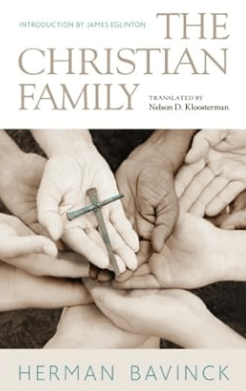
I am an unabashed Herman Bavinck enthusiast. (One of my goals is to read everything by him that has been published in English. So far, I’ve completed his four-volume Reformed Dogmatics, Wonderful Works of God, Philosophy of Revelation, Preaching and Preachers, and Christian Worldview. I’m working on his Essays on Religion, Science, and Society, Reformed Ethics, and still need to acquire some other of his works.) I liked this book so much that I read most of it and gave it away before I could finish reading it all! Nevertheless, what I did read was characteristically rich. This reviewer says it well: “Accessible, thoroughly biblical, and astonishingly relevant, it offers a mature and concise handling of the origins of marriage and family life and the effects of sin on these institutions, an appraisal of historic Christian approaches, and an attempt to apply that theology.”
If you decide to read this book, you should be aware of Bavinck’s historical context (the Netherlands in 1908) and purpose (a theology, not a practical manual). While his theology is sound, some applications of that theology Bavinck himself would later change. For example, he at first opposed, and then supported, women’s right to vote. As Eglinton notes in the introduction, this “should serve as a useful reminder of the need for a careful contemporary reading of Bavinck’s practical applications on the family.”
“The creation story in Genesis shows . . . that both [man and woman] have been created in God’s image (Gen. 1:27). Not merely one of them, but both, and not the one separate from the other, but man and woman together, in mutual relation, each created in his or her own manner and each in a speical dimension created in God’s image and together displaying God’s likeness. For this reason the Lord compares himself not only to a Father who takes pity on his children (Psalm 103:13), but also to a mother who cannot forget her nursing child (Isa. 49:15). He chastens like a father (Heb. 12:6), but he also comforts like a mother (Isa. 66:13), and replenishes for the loss of both (Ps. 27:10).”
– Herman Bavinck
The Brothers Karamazov by Fyodor Dostoevsky
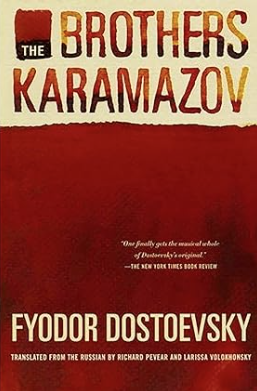
I heard somewhere that college students, instead of taking psychology courses, should read the Russian 19th-century novelists Dostoesvsky and Tolstoy. I am inclined to agree with this.
I first read The Brothers Karamazov when I was in college recovering from strep throat, and I read it again this past year. Like any great book, I discovered that it grew with me. I learned more from the second reading than from the first. Now I am reading it a third time.
The Brothers Karamazov is a long and arduous read. It requires patience, persistence, as well as a pencil and notebook (to keep track of all the characters and their various nicknames). But I believe the effort will be well-rewarded by a keener insight into the paradoxes of human nature, the problem of evil, and the splendor of the Christian faith.
“Above all, don’t lie to yourself. The man who lies to himself and listens to his own lie comes to a point that he cannot distinguish the truth within him, or around him, and so loses all respect for himself and for others. And having no respect he ceases to love.”
– Fyodor Dostoevsky
***
“I believe like a child that suffering will be healed and made up for, that all the humiliating absurdity of human contradictions will vanish like a pitiful mirage, like the despicable fabrication of the impotent and infinitely small Euclidean mind of man, that in the world’s finale, at the moment of eternal harmony, something so precious will come to pass that it will suffice for all hearts, for the comforting of all resentments, for the atonement of all the crimes of humanity, for all the blood that they’ve shed; that it will make it not only possible to forgive but to justify all that has happened.”
Nothing to Be Frightened Of by Julian Barnes

“I don’t believe God, but I miss him.” These opening words express the theme of Barnes’ entire book as well as the general malaise of our post-Christian age. This is the sort of book to read as the Apostle Paul must have read the pagan poets Aratus and Epimenides—not to be edified, but to see that even godless men, when they are honest, may be the mouthpiece of profound truth.
I doubt that Julian Barnes himself would object to my calling him “godless,” since he remains cautiously skeptical about God’s very existence, and does not hesitate to use Jesus’ name as a curse word. Nevertheless, in his utter (and often profane) honesty, Barnes gives startling clarity to humans’ fear of death (Hebrews 2:15), craving to be known, loved, and justified, and suspicion that no one is righteous enough to validate their own existence, among other things.
“When we fall in love, we hope—both egoistically and altruistically—that we shall be finally, truly seen: judged and approved . . . [God:] ‘You want to be seen and approved? . . . Really, let’s be honest with one another: do you think you deserve eternal life as a reward for your human existence? Doesn’t that strike you as a gross jackpot to win for such a trifling fifty-to-a-hundred-year investment?”
– Julian Barnes
***
“Missing God is focused for me by missing the underlying sense of purpose and belief when confronted with religious art. It is one of the haunting hypotheticals for the nonbeliever: what would it be like ‘if it were true’?”
Timothy Keller: His Spiritual and Intellectual Formation by Collin Hansen
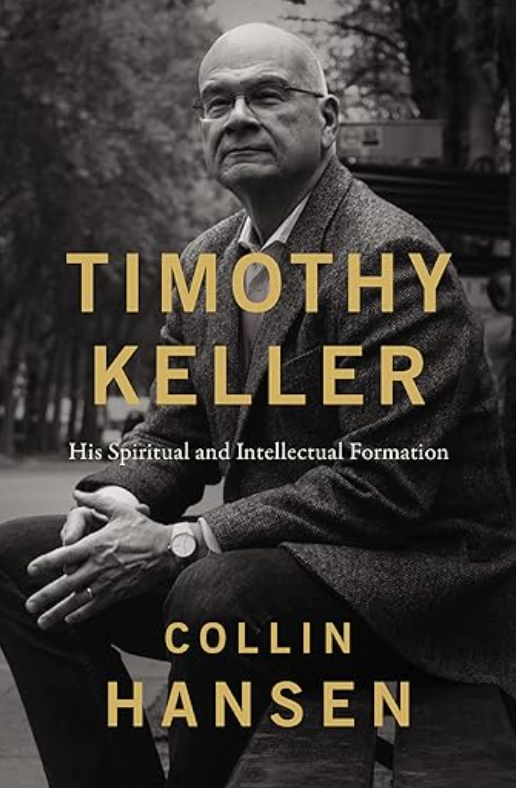
I’ve benefited immensely from Keller’s sermons and writings, and was very sad when he passed away in May of 2023.
In Tim Keller Hansen takes readers chronologically through Keller’s life, focusing (as the subtitle indicates) on the books and people that shaped his mind and heart.
A book that not only follows the life of this great Christian leader, but also points to the great leaders that influenced him—that’s a book I can get excited about. When reading it before bed, I had a hard time putting it down, and an even harder time getting to sleep after I did.
“As public intellectuals, pastors are not commonly known for citing their sources. In fact they’re often explicitly discouraged in training from doing so, for fear of distracting the congregation with author and book names they won’t remember. Keller breaks that mold. From Tolkien to Taylor, Clowney to Conn, Keller shows his work, so we can carry on his project. Future generations will honor Keller better by reading his library than by quoting him.”
– Collin Hansen
The Return of the King by J. R. R. Tolkien
It was high time I read this classic work by Tolkien (I had read The Hobbit, Fellowship of the Ring, and The Two Towers, and finished, of course, with The Return of the King). Entering into Middle Earth does require some cultural and geographical adjustment, but, like any kind of travel, the experience is enriching.
What can I say? Tolkien has created characters, places, images, and plots which, once thought, cannot be unthought. He also has passages that make the heart sing and soar and certain that there must be a heaven or nothing at all.
“It is not our part to master all the tides of the world, but to do what is in us for the succour of those years wherein we are set, uprooting the evil in the fields that we know, so that those who live after may have clean earth to till. What weather they shall have is not ours to rule.”
– J. R. R. Tolkien
***
“And the ship went out into the High Sea and passed into the West, until at last on a night of rain Frodo smelled a sweet fragrance on the air and heard the sound of singing that came over the water. And then it seemed to him that as in his dream in the house of Bombadil, the grey rain-curtain turned all to silver glass and was rolled back, and he beheld white shores and beyond them a far green country under a swift sunrise.”
Testimony: Inside the Evangelical Movement that Failed a Generation by Jon Ward
The past few years have seen a rise in “exvangelicals” and “Christian deconstruction” stories, but this is not one of them. Although Jon Ward delivers some painful criticism evangelicals should be attentive to, he remains committed to Christianity and even optimistic about evangelicals.
I reviewed this book on my blog, and noted that it “is a story that, in the end, celebrates instead of despises Christianity. Ward concludes Testimony not by imagining a world without Christianity, but by asking, ‘What would a more Christian witness look like?’”
“I still don’t claim to know how to walk the way of the cross or the path of resurrection very well. But I think that the quest to do so is still at the heart of a meaningful faith. What does it look like to live sacrificially but also incarnationally? Christ was God incarnate, made flesh. How do we walk through death to life, here, now?”
– Jon Ward
 Jonathan M. Threlfall